


Raised in Noise: How Children Learn to Feel Without Silence
——When Emotion Must Compete for Volume
By Adrian Keller | Updated on March 3, 2026 | 🕓12–15 minutes
Key Highlights
- Why do some children only express emotions by shouting instead of speaking calmly?
- How does constant background noise shape a child’s emotional habits over time?
- Are sibling conflicts really about personality—or competition for attention in a noisy environment?
- What happens to children who are naturally quiet in loud households?
- Why is “quiet” essential for emotional regulation and self-awareness?
- How does limited space and constant noise create hidden inequality in children’s emotional development?
Children who grow up in noise come to understand emotion much like fish raised in water understand wetness—it is an all-encompassing medium, so deeply immersive that it becomes indistinguishable from the background of existence itself. Over time, it does not merely surround them; it shapes the architecture of their perceptual system.
A family’s acoustic landscape is, at its core, a structure of power distribution. It is also the very air in which emotions breathe.
The Family Soundscape — A Neglected Ecological Variable
Environmental psychology reminds us that human beings are not only products of society, but also products of space. Reports from the World Health Organization (WHO) often focus on noise-induced hearing loss or physiological stress responses. Yet for children, household noise functions less as an acute threat and more as a chronic, low-grade psychological load.
Sound as a Currency of Attention
Within any family ecosystem where resources are limited, attention is the scarcest currency. When visual space is crowded and private time is scarce, sound becomes the primary tool for competing for that attention. Those who are louder, sharper, or more persistent are more likely to be noticed.
The Instrumentalization of Emotion
In such environments, emotional expression—especially crying or shouting—ceases to be a spontaneous outflow of inner experience. It gradually becomes instrumentalized into strategy. Children unconsciously learn that calm expression dissolves into background noise; only increased volume can cut through the “acoustic fog” and secure a response.
The Silent Competitors
Children who are naturally quiet or sensory-sensitive often withdraw from this competition. It is not that they lack emotions. Rather, their expressions dissipate before reaching a receptive listener. Over time, this disappearance fosters helplessness: My feelings must not matter, because no one can hear them.
This environment does not teach children to consume more material goods; it teaches them to expend more vocal force simply to prove their existence.
Spatial Density and Sibling Conflict — Not Personality, but Acoustic Congestion
Drawing on Murray Bowen’s family systems theory, we can understand the family as an emotional unit. When physical space is cramped, sound reverberates, and there are no effective zones of acoustic separation (such as doors that close or quiet corners), the system experiences what we might call “acoustic congestion.”
Lowered Emotional Thresholds
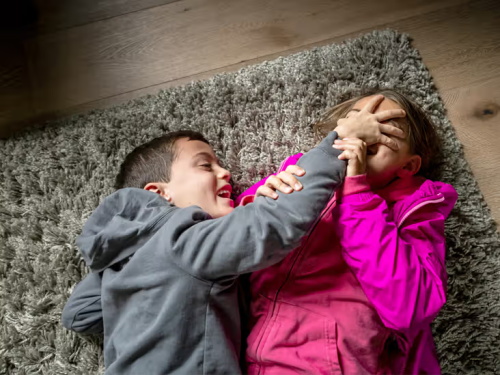
In a background of continuous, uncontrollable noise—television left on, kitchen appliances humming, multiple electronic devices sounding—the central nervous system remains in a heightened state of alertness. Emotional regulation thresholds drop. What might otherwise be a minor shove escalates quickly into a heated argument or tears under sensory overload.
Interruptive Expression and Competitive Communication
Sibling conflict is often attributed to “personality clashes” or “jealousy.” Yet through the lens of the soundscape, it resembles an acoustic struggle for space.
- Only by interrupting can one secure speaking time.
- Only by speaking louder can one ensure that a parent hears the grievance.
Communication becomes less about exchanging information and more about overpowering the other. Turn-taking is difficult to learn in an environment without pauses—there is no experience of “waiting for an echo,” only anxiety about sustaining one’s own signal.
How Quiet Shapes Emotional Structure
Quiet plays a far more critical role in emotional development than we often assume. It is not an emotional void, but an integration chamber.
James Gross’s process model of emotion regulation suggests that regulation unfolds across the entire emotional timeline. Quiet environments provide the essential conditions for key phases: cognitive reappraisal and response modulation.
Children Raised in Persistent Noise
Blurred interoception
In a constant state of high arousal, children struggle to distinguish: Is this anxiety mine, or irritation triggered by external noise? They rely on external cues—others shouting, raised voices—to assess threat, rather than internal bodily signals.
No space for reflection
Without an “echo period,” one stimulus immediately replaces another. Emotions never fully land. Experiences cannot consolidate into narrative memory.
Children Raised with Stable Quiet Structures
Emotions land
After conflict, quiet imposes a natural pause. In this space, the brain can replay events, converting emotional experiences into language and memory.
Hearing oneself
Only in relative quiet can a child notice their heartbeat, breath, and the faint inner voice of reflection. This self-directed dialogue forms the foundation of advanced emotional skills—self-soothing, perspective-taking, and delayed response.
Has Family Sound Been Performance-Managed?
Modern efficiency logic has seeped into family life, and sound is no exception. Voices and emotions are increasingly subjected to performance management.
The Logic of Regulation
“Stop crying.”
“Lower your voice—the neighbors will complain.”
“Hurry up and say it; I’m busy.”
Embedded in these everyday phrases is an assumption: sound is interference, emotion is inefficiency.
Compressed Emotional Expression
Under such regulation, children learn to produce “compressed” emotional outputs:
- Express quickly—or lose the opportunity.
- Simplify feelings—complexity invites impatience.
- Compress depth—deep sorrow requires time, but time is scarce.
The result: children may become efficient communicators of information, yet struggle to narrate complex emotional stories.
A Deeper Fault Line: Sound as Class Difference
Ultimately, the soundscape reveals a form of “acoustic stratification.” This is not merely economic; it is about spatial rights.
High-Density Households (Often Resource-Constrained)
- Layered sound: television, phones, conversation, street noise merging into constant acoustic saturation.
- Disappearing boundaries: no doors to close means no private corners to contain emotion. Children lack backstage space; they are perpetually on the front stage—performing or defending.
Low-Density Households (Often Resource-Abundant)
- Sound boundaries: independent rooms offer acoustic autonomy. Doors can open for connection or close for solitude.
- The luxury of solitude: alone time is not emptiness but psychological regeneration.
This is not an indictment of material conditions. It is an observation: whoever possesses acoustic boundaries possesses the fundamental right to organize emotion and construct a deeper self. Without such boundaries, children must devote significant energy to defending against intrusion—energy that might otherwise fuel growth.
In the End
Imagine a child raised in noise, now an adult.
One evening, he sits alone on a balcony at dusk. For once, the world is quiet—no traffic below, no arguing neighbors, no notifications. In this rare, nearly transparent stillness, panic flickers. He feels compelled to turn on the television or scroll his phone, to fill the void.
But in the crack of that fear, he hears his breathing—steady, elongated. Then his heartbeat. And then, rising slowly, feelings long suppressed, never before allowed to surface in full.
He realizes: emotion does not exist only when shouted. Feelings can be heard in silence; they need not be fought for in noise.
Have we underestimated the value of quiet?
Perhaps quiet is not emptiness at all.
Perhaps it is the only place where the soul can truly amplify itself.
FAQs
1. Does a noisy home really affect a child’s emotional development, or is this exaggerated?
It’s not just about volume, but consistency. Occasional noise is harmless, but chronic, unmanaged noise can raise stress levels, reduce emotional awareness, and shape how children learn to express themselves—often pushing them toward louder, more reactive communication.
2. Why does my child seem to ignore me unless I raise my voice too?
Children adapt to the dominant communication style around them. If the environment is loud, they may unconsciously learn that only high volume gets attention. Over time, calm voices become “invisible” in their perception.
3. Is shouting always a bad sign, or can it be part of normal development?
Shouting can be developmentally normal, especially in younger children. The concern arises when it becomes the primary or only way a child expresses needs or emotions, suggesting they haven’t learned alternative, effective ways to be heard.
4. What about children who become very quiet instead of loud? Should I worry?
Not necessarily—but it’s important to pay attention. Some children withdraw not because they lack feelings, but because they’ve learned their expressions don’t get noticed. Over time, this can affect confidence and emotional communication.
5. How can parents create “quiet” if their living space is small or busy?
Quiet doesn’t require a large home. Even small, consistent practices can help:
- turning off background TV when not in use
- creating short daily “no-noise” periods
- designating a corner or routine as a calm space
- What matters is predictability, not perfection.
6. Will reducing noise immediately improve my child’s behavior?
Not instantly. Children need time to adjust to a different emotional environment. At first, silence may even feel uncomfortable to them. But gradually, quieter spaces allow emotions to slow down, become clearer, and be expressed more thoughtfully.
7. How can I help my child express emotions without shouting?
Modeling is key. Speak at a steady volume, pause before responding, and acknowledge emotions even when expressed loudly. Over time, children learn that being understood does not require escalation.
References
1. Evans, G. W., & Lepore, S. J. (1993). Nonauditory effects of noise on children: A critical review. Children’s Environments, 10 (1), 31–51.
2. Evans, G. W., Hygge, S., & Bullinger, M. (1995). Chronic noise and psychological stress. Psychological Science, 6 (6), 333–338.
3. Gross, J. J. (2015). Emotion regulation: Current status and future prospects. Psychological Inquiry, 26 (1), 1–26.
4. Lercher, P., Evans, G. W., & Meis, M. (2003). Ambient noise and cognitive processes among primary schoolchildren. Environment and Behavior, 35 (6), 725–735.
About the Author
Dr. Adrian Keller, PhD
Dr. Adrian Keller is a developmental psychologist and researcher specializing in environmental influences on emotional regulation and family systems. He received his PhD in Developmental Psychology from the University of Amsterdam and has contributed to interdisciplinary research on spatial ecology, stress physiology, and child development. His work focuses on how built environments and social structures shape emotional architecture across the lifespan.
Editorial Transparency Statement
This article is an independent analytical essay grounded in established psychological theory and environmental research. No commercial funding or sponsorship influenced the development of this content. All referenced studies are publicly accessible academic sources. Interpretations presented here represent the author’s synthesis of existing research and theoretical frameworks.
Professional & Educational Disclaimer
This article is intended for educational and informational purposes only. It does not constitute psychological, medical, or therapeutic advice. Readers experiencing significant emotional distress or family conflict are encouraged to consult a licensed mental health professional or qualified healthcare provider.
Recommended for you: