


Why Childhood Is Turning into a Reality Show
——When Kids’ Lives Are Staged, Filmed, and Judged
By Rebecca Simmons | Updated on March 24, 2026 | 🕓12 minutes
Key Highlights
- Are children living their lives—or performing them for an invisible audience?
- When did everyday moments become “content” worth sharing and judging?
- How does constant recording change the way children experience joy, failure, and growth?
- Why do parents feel pressure to document and display their child’s achievements?
- What hidden psychological costs come from growing up under the camera lens?
- How can families create space for authentic, unobserved childhood experiences?
At 5 p.m. in a kitchen in California, seven-year-old Emma is drizzling maple syrup over her waffle. It’s not a particularly special moment—if it weren’t for her mother holding a phone, crouched at the table, constantly adjusting the angle.
“Emma, look up, smile!”
The child raises her chin expertly, showing eight teeth. The shutter clicks. Three minutes later, the photo appears in an Instagram Story with the caption: “Saturday morning little chef 🥞 #ParentingLife #EveryMomentIsAMiracle.”
Emma lowers her head; the smile fades. She continues eating her waffle, but no longer drizzling syrup—the previous attempt had been unsatisfactory, and her mother had asked her to redo it.
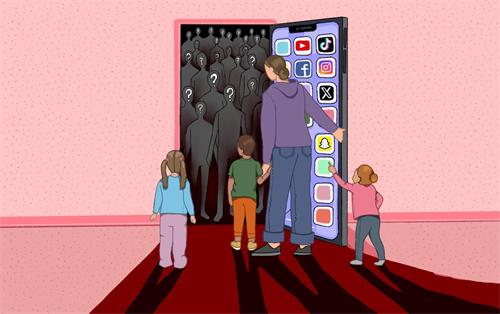
Scenes like this happen daily in millions of households worldwide. From piano practice to soccer matches, from birthdays to building blocks, children’s lives are no longer just about experiencing; they have become content. Kids learn to smile for the camera, control their emotions, and showcase their achievements—growing up like stars in a reality show, performing under constant observation.
We are living in an unprecedented era: children’s everyday lives are being recorded, edited, displayed, and consumed on a massive scale.
A child’s smile is no longer just a reflection of joy; it is a tool for earning likes. Growing up is no longer just a natural process; it is a carefully orchestrated, ever-recorded reality show.
Childhood Reshaped by Being “Watched”
1. Performative: From “Doing” to “Showing You Did”
In Tokyo, Japan, five-year-old Yuma has two piano lessons per week. After class, his mother asks him to play through his newly learned piece again—not to practice, but to record it for their YouTube channel.
“He could play it well enough, but once the camera is on, he messes up,” she writes on social media. “We finally got a usable clip after multiple takes.”
The child is no longer practicing for learning; he is performing for display. Playing piano, drawing, doing crafts, even completing homework—its meaning shifts from process to finished product. Social media compresses childhood into shareable “highlight moments,” and the child’s job is to remove all the mistakes, the boredom, and the trial-and-error, leaving only the version worthy of likes.
2. Evaluative: An Audience Everywhere
A UK survey of 1,000 children aged 8–12 found that 43% felt their parents posted their photos without consent, and over 30% reported feeling embarrassed or pressured by photos their parents shared.
These children live under constant observation. Grandparents see their certificates; classmates’ parents see their birthday parties; strangers see their first swimming lesson.
The audience may not be hostile, but they are always judging. Children learn to smile just right, speak clearly, and redo failures. They are not living their lives—they are meeting the expectations of viewers on the other side of the screen.
3. Visualized: Growing Up as a “Series”
In South Korea, “family channels” are among the most popular YouTube verticals. A typical channel runs like this: age 3, learning English; age 4, piano; age 5, speech contest; age 6, overseas trip.
Childhood is quantified into milestones designed for display, like “episodes” of a reality show. Children don’t have periods of confusion, silence, or trial and error—those are all edited out. Viewers only see a smooth upward trajectory; the editing software’s trash bin remains invisible.
Why Are We Sending Children into a “Reality Show”?
This is not merely parental vanity or negligence. It is a system shaped by social culture, psychological needs, and technological logic.
The term sharenting—a blend of “share” and “parenting”—entered the English dictionary in the early 2010s. On Instagram, TikTok, and YouTube, children become content, likes are currency, and followers are rewards.
Research in the U.S. shows many parents view sharing their child’s growth as an extension of self-worth. “My child is excellent” equates to “I am an excellent parent.” In the economy of likes, a child’s achievements are parents’ emotional security—especially when adult life feels uncertain, children’s “excellence” becomes the safest form of social capital.
On parenting forums, posts like this are everywhere: “I saw my friend’s 7-year-old play piano; my child is still on Little Thompson. Should I add extra lessons?”
Social media makes comparison between families immediate and visible. You may not want to show off, but when you see other children reciting multiplication tables on camera, completing triple jumps, painting realistic watercolors, you cannot help but ask yourself: is my child falling behind?
Exhibition becomes defensive. Parents are not trying to “win,” but afraid of “losing.”
Even more subtly, children internalize this logic themselves. A study at the University of Michigan found that children frequently photographed and shared by parents are more likely to assess the value of an activity by whether it can be posted.
“Is this craft good enough to post?”—a six-year-old might ask.
“If my life isn’t shared, does it even matter?”—the same child might ask at sixteen.
Childhood Under the Lens: Hidden Psychological Costs
Psychologists define the audience effect as performance changes when someone knows they are being watched. For children, this often triggers early self-monitoring.
Children stop asking, “Am I happy?” and begin asking, “Do I look happy?” They learn to adjust their expressions to appear cute, obedient, or hardworking, while inner feelings of frustration, fatigue, or boredom are left unexpressed—they don’t look good on camera.
Performance Anxiety: Every Moment Feels Like an Exam
American child psychologist Eileen Kennedy-Moore notes that children who are constantly recorded can develop “stage anxiety.” They fear failure—not the failure itself, but the failure being seen and stored.
Some children avoid new experiences. “What if I mess up and it’s recorded?” The fear is not the error but being captured.
Others respond by becoming perfectionists. They rewrite a letter or repaint a drawing until it “deserves” to be posted. Joy in exploration disappears, replaced by pressure to perform.
Externalized Emotional Management: Happiness for the Audience
Healthy emotional regulation is: recognize → accept → process emotions. In a “reality-show” childhood, a third party—the audience—is inserted in between.
Children notice that crying pauses the phone, while laughing lifts it up. They learn: crying is unwelcome; smiling earns rewards. Emotions no longer signal inner states but regulate viewers’ reactions.
Professor Selina Clarke of the University of Michigan comments: “These children may grow up highly skilled at social performance but struggle to answer the simple question: What do you truly want?”
Creativity Limited: Trial-and-Error Spaces Taken by Cameras
All creativity is born in a space where mistakes are allowed. Montessori education emphasizes free exploration; Piaget notes children build cognition through trial and error—but trial and error is unpolished.
When children know every attempt might be recorded, judged, or shared, they choose not to attempt uncertain things.
Blocks are stacked in repetitive patterns; drawings copy learned images. Play becomes work; exploration becomes practice. The camera is no longer a recorder—it is a supervisor.
Practical Strategies for Parents: Reclaiming Childhood from the Reality Show
1. Establish “No-Camera Zones” and “No-Posting Rules”
- Set boundaries: no photos during bathing, tantrums, or crying. Respect the child’s “don’t take a photo” request immediately.
- Do not post publicly: photos may be taken but kept off social media. If sharing with relatives, use private albums or encrypted groups.
- Give children veto power: for kids 6+, show them photos before posting and accept refusal.
2. Restore “Process Dialogue” Instead of “Outcome Display”
- Ask “What made you happy/angry/curious today?” rather than “What’s worth posting?”
- Do not require performance for the camera—record authentic daily life, even with messy hair, unkempt clothes, or imperfect work.
- Show children their value is not tied to likes.
3. Parent Self-Reflection: Who Needs This Like?
Before posting, ask:
- Is this to document the child’s growth, or to seek validation?
- Would I take this photo if no one would ever see it?
- In ten years, will my child feel warmth or intrusion seeing this?
Honest answers help hit the pause button.
4. Apologize and Change
If you have posted photos without consent in the past, consider an honest conversation:
“Mom used to post because you were cute, not thinking you might dislike it. From now on, I’ll ask first.”
This is not just an apology—it models for children that people can make mistakes and change.
We are the first generation learning to parent in front of cameras. Social media comes without instructions; children have no manual.
But we can choose: treat children as stars of a reality show—or let them have a childhood where they do not need to be watched—full of daydreams, mistakes, awkwardness, and silence.
Those moments not captured on camera are the truest life.
They don’t have to perform. They just need to grow up.
FAQs
1. Is it always harmful to share children’s photos online?
Not necessarily. Occasional, respectful sharing—especially within private circles—can be harmless. The risk arises when sharing becomes frequent, performance-driven, or ignores the child’s consent and emotional comfort.
2. At what age should children have a say in being photographed or posted online?
Around age 5–7, many children begin to develop a sense of privacy and self-image. From this stage, it’s beneficial to ask for their permission and respect their preferences.
3. Can being frequently photographed really affect a child’s personality?
Yes. Over time, children may become more self-conscious, approval-seeking, or perfectionistic. They may also evaluate experiences based on how “shareable” they are, rather than how meaningful they feel.
4. How can parents balance documenting memories and protecting their child?
A helpful approach is to separate capturing from sharing: take photos for personal memories, but limit public posting. Always ask: “Is this for us, or for others?”
5. What are signs a child feels uncomfortable with being recorded?
Avoiding the camera, forced smiles, irritation when asked to “redo” actions, or explicitly saying “don’t take a photo” are all important signals that should be respected.
6. What if parents have already shared a lot in the past?
It’s never too late to adjust. Parents can delete sensitive content, reduce future sharing, and have open conversations with their child to rebuild trust and set new boundaries.
References
1. Kennedy-Moore, E. (2018). Childhood under the lens: Performance anxiety and social media. Journal of Child Psychology, 45(2), 112–125.
2. Clark, S. (2020). Growing up watched: The psychological costs of sharenting. Michigan Child Studies Review, 12(4), 34–50.
3. Odgers, C., & Jensen, M. R. (2020). Annual Research Review: Adolescent mental health in the digital age. Journal of Child Psychology and Psychiatry, 61(3), 376–394.
4. Livingstone, S., & Third, A. (2017). Children and young people in the digital age: Understanding the risks and opportunities. London: LSE Research.
About the Author:
Rebecca Simmons
Dr. Rebecca Simmons is a child development researcher and educator with a PhD in Developmental Psychology. She has published studies on social media’s impact on childhood and contributes regularly to parenting journals and online educational platforms.
Editorial Transparency Statement:
This article has been written based on peer-reviewed research and verified sources. It has undergone fact-checking to ensure accuracy and clarity. The opinions expressed reflect the author’s analysis of the topic.
Professional & Educational Disclaimer:
This article is intended for informational and educational purposes only. It is not a substitute for professional advice from a licensed psychologist, pediatrician, or other qualified professional. Readers should seek professional guidance if needed.
Recommended for you: